

 Pumps
PumpsRole of Pump Casing and Impeller in performance of Blower

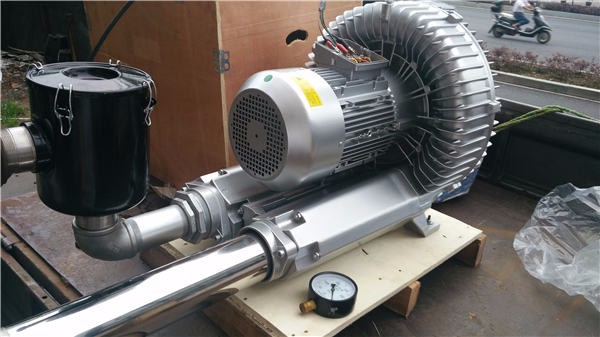
In the core architecture of high-speed centrifugal blowers, the casing (also known as the housing or volute) and the impeller are the two most critical components. Functioning like the “heart” and “thorax” of the machine, they collectively determine the blower’s performance, operational efficiency, and service life. Achieving excellence in the design and manufacturing of these components is the only way to provide truly efficient and reliable industrial fluid solutions.
I. Working Principle: Energy Transfer and Transformation
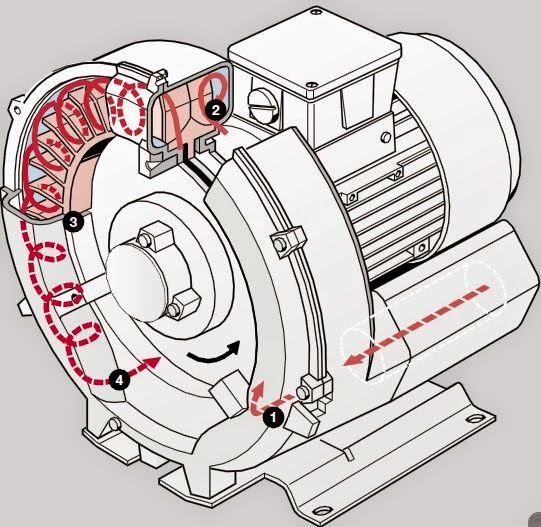
When the impeller rotates at high speeds driven by a motor, the gas trapped between the blades is flung toward the outer edge due to centrifugal force. This causes the gas to gain energy, increasing both its pressure potential energy and kinetic energy.
Simultaneously, a vacuum forms at the center of the impeller, allowing external gas to be continuously drawn in by atmospheric pressure, creating a steady flow. The essence of this process is the transformation of energy: the mechanical energy from the driver is transferred to the gas via the impeller, and the casing then collects this high-speed gas, converting a portion of its kinetic energy into additional pressure energy.
II. The Impeller: The Core of Energy Generation
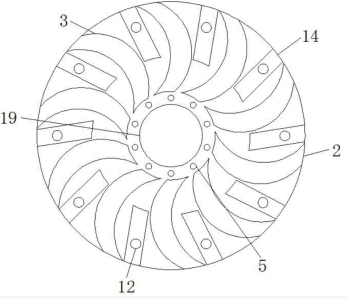
The impeller is the primary component that transfers mechanical energy to the gas. Its importance is reflected in several key areas:
- The First Stage of Conversion: As the starting point of energy transfer, the impeller’s design directly dictates the pressure head and flow rate. Advanced designs utilize Three-Dimensional (3D) Flow Theory, using mathematical models to simulate fluid trajectories and ensure the blade profile perfectly matches actual airflow patterns.
- Structural Complexity: Modern impellers often utilize airfoil-shaped blades which offer superior aerodynamic characteristics, high strength, and high rigidity. High-performance designs frequently feature a “long-and-short blade” backward-curved layout. This allows for a wider regulation range (typically 45%–100% of rated flow), making the blower adaptable to various industrial conditions.
- Efficiency Determinant: Precision is paramount. Utilizing five-axis CNC machining ensures the blade profile meets exact design specifications with high surface smoothness. When paired with aerospace-grade aluminum alloys and strict dynamic balancing (such as G2.5 grade), impeller efficiency can exceed 95%.
III. The Casing: Key to Energy Collection and Conversion
The casing performs the dual function of gas collection and further energy transformation:
- Collection and Guidance: Comprising the volute, the tongue (cut-off), and the inlet/outlet, the casing acts as a precision “collector.” It ensures gas flows smoothly out of the blower and into the piping system with minimal resistance.
- Kinetic to Pressure Energy Conversion: As high-speed gas exits the impeller and enters the gradually expanding volute passage, its velocity decreases. According to Bernoulli’s Principle, this reduction in velocity converts kinetic energy into static pressure.
- Component Matching: The geometric parameters of the casing—such as the tongue angle and the expansion rate of the flow path—must be perfectly matched to the impeller. Improper matching leads to turbulence, increased pressure pulsations, and noise.
IV. The Synergy Between Components
The impeller and casing do not work in isolation; they form a cohesive organic system:
- A Complete Energy Chain: Any inefficiency in either the impeller’s generation of energy or the casing’s conversion of that energy will degrade the entire system’s performance.
- Stability and Longevity: The clearance between the impeller and the casing, along with the design of the seal rings, determines the volumetric efficiency by reducing leakage.
- Vibration and Noise Control: High-precision matching, combined with quality bearings (such as ceramic ball bearings), ensures that even at high rotational speeds, the blower maintains minimal vibration and noise levels.
V. Impact on Real-World Performance
In practical industrial applications, the optimization of these two components yields tangible benefits:
- Energy Consumption: High-efficiency designs can significantly reduce power requirements. For example, replacing a traditional 20kW blower with a high-speed permanent magnet blower featuring an optimized 3D-flow impeller can often result in actual operating power as low as 7.6kW, leading to massive annual electricity savings.
- Operational Range: A well-matched system allows the blower to remain in its “high-efficiency zone” even when flow requirements fluctuate, providing excellent adaptability to production load changes.
- Reliability: Using high-strength materials and precision balancing reduces wear and tear on internal components, extending the equipment’s lifespan and lowering maintenance costs in harsh industrial environments.
Conclusion
The impeller acts as the core of energy input, while the casing serves as the gateway for energy conversion and collection. Both are indispensable. In the design and maintenance of industrial blowers, the synergy between these two components is the foundation of excellence. By combining 3D-flow theory, precision CNC machining, and integrated CFD (Computational Fluid Dynamics) simulation, modern fluid technology continues to drive industrial green manufacturing and sustainable development.