
 Pumps
PumpsRegenerative Blower Certifications Explained

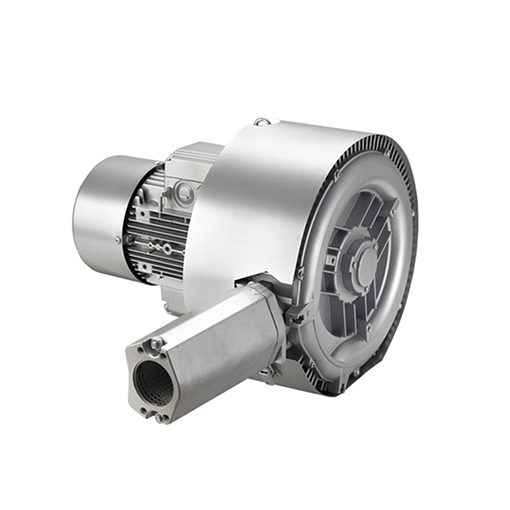
Industrial buyers today no longer focus only on airflow and pressure when selecting a regenerative blower. Certifications have become one of the most important factors in international procurement, especially for wastewater treatment, pneumatic conveying, aquaculture, packaging automation, medical equipment, and hazardous industrial environments.
Different countries and industries require different compliance standards. A regenerative blower that can enter the European market may still be restricted in North America or Russia if it does not meet local certification requirements.
Understanding blower certifications helps buyers:
- Avoid import restrictions
- Meet project bidding requirements
- Improve operational safety
- Ensure electrical compliance
- Reduce legal and insurance risks
- Increase equipment reliability
This article explains the most common regenerative blower certifications used in global industrial markets and why they matter for your applications.
Why Certifications Matter for Regenerative Blowers
Regenerative blowers are widely used in continuous-duty industrial systems. Since these machines involve:
- Electric motors
- High-speed impellers
- Pressure and vacuum operation
- Heat generation
- Industrial electrical connections
they must comply with safety and environmental standards before entering many international markets.
Certified blowers typically provide:
- Better electrical safety
- More stable operation
- Lower environmental risks
- Higher manufacturing consistency
- Easier customs clearance
For many engineering projects, certifications are mandatory rather than optional.
CE Certification for the European Market
What Is CE Certification?
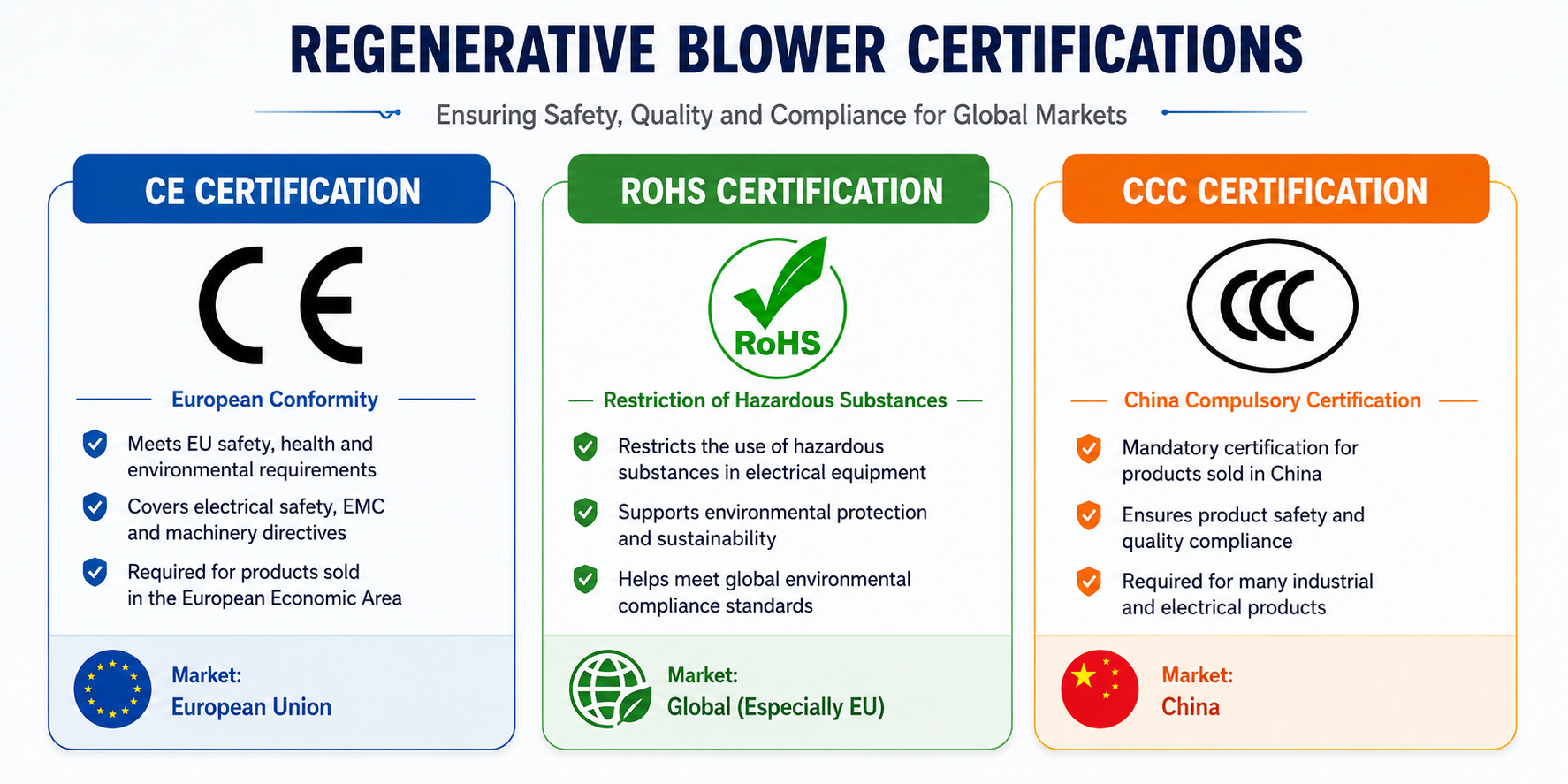
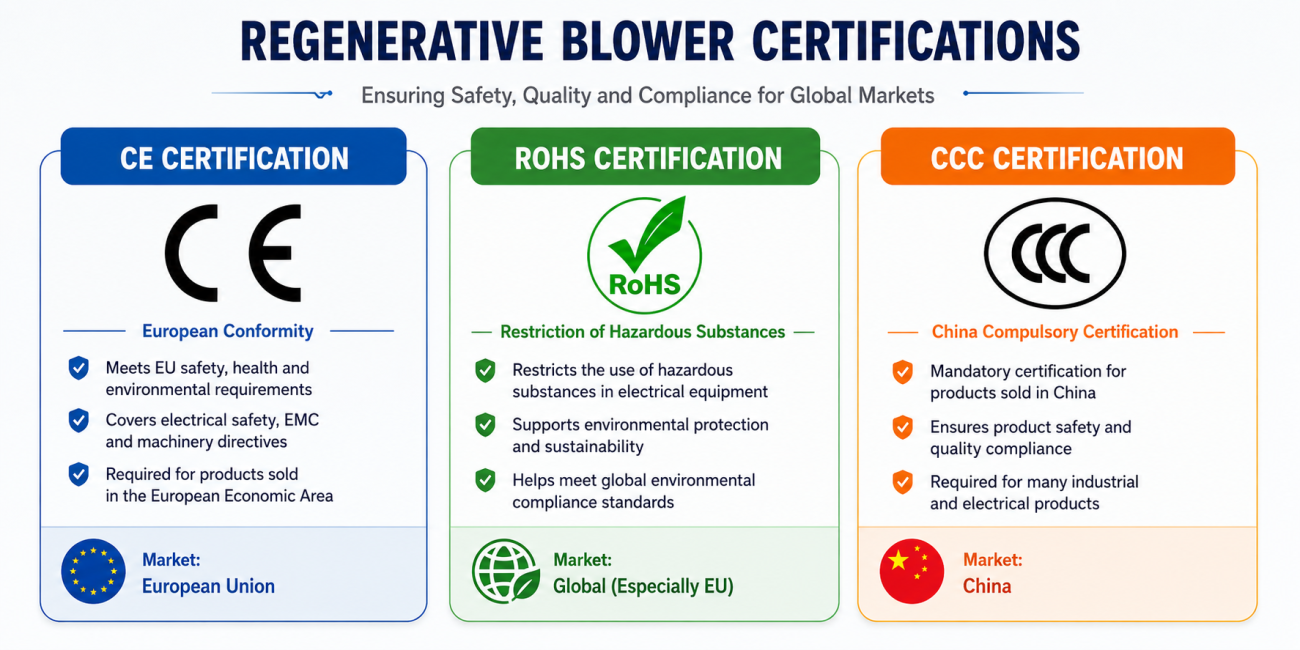
CE certification indicates that a regenerative blower complies with European Union safety, health, and environmental protection regulations.
It is one of the most common certifications required for industrial equipment entering Europe.
What Does CE Cover?
For regenerative blowers, CE usually includes:
- Electrical safety
- Mechanical safety
- Electromagnetic compatibility
- Machinery directive compliance
- Low voltage directive compliance
Manufacturers must ensure the blower meets applicable EU directives before applying the CE mark.
Industries That Commonly Require CE Blowers
CE-certified regenerative blowers are widely used in:
- Wastewater treatment
- Food packaging
- Printing machinery
- Textile systems
- Pneumatic conveying
- Industrial automation
Without CE certification, many distributors and EPC contractors in Europe will not accept the equipment.
RoHS Certification and Environmental Compliance
What Is RoHS?
RoHS stands for Restriction of Hazardous Substances.
This certification controls the use of harmful materials in electrical equipment.
Restricted Materials Include
RoHS limits substances such as:
- Lead
- Mercury
- Cadmium
- Hexavalent chromium
- Certain flame retardants
Why RoHS Matters for Regenerative Blowers
Although regenerative blowers are industrial products, many customers still require RoHS compliance because:
- It supports environmental regulations
- It reduces hazardous waste risks
- It improves sustainability standards
- It helps meet corporate ESG requirements
RoHS is especially important for:
- Medical equipment
- Electronics manufacturing
- Food processing systems
- Export-oriented industrial projects
Many buyers today prefer CE + RoHS combinations for European procurement.
CCC Certification for the Chinese Market
What Is CCC Certification?
CCC stands for China Compulsory Certification.
It is a mandatory certification system for products sold within China.
Why CCC Is Important
For regenerative blowers using electric motors and industrial electrical components, CCC certification may be required depending on:
- Motor configuration
- Voltage range
- End-use application
Without CCC certification, products may face:
- Customs delays
- Market access restrictions
- Project approval difficulties
Common Applications
CCC-certified regenerative blowers are often used in:
- Industrial machinery
- Factory automation
- Environmental protection equipment
- Packaging lines
- Central conveying systems
CCC is particularly important for local industrial projects and government-related procurement.
UL Certification for North America
What Is UL Certification?
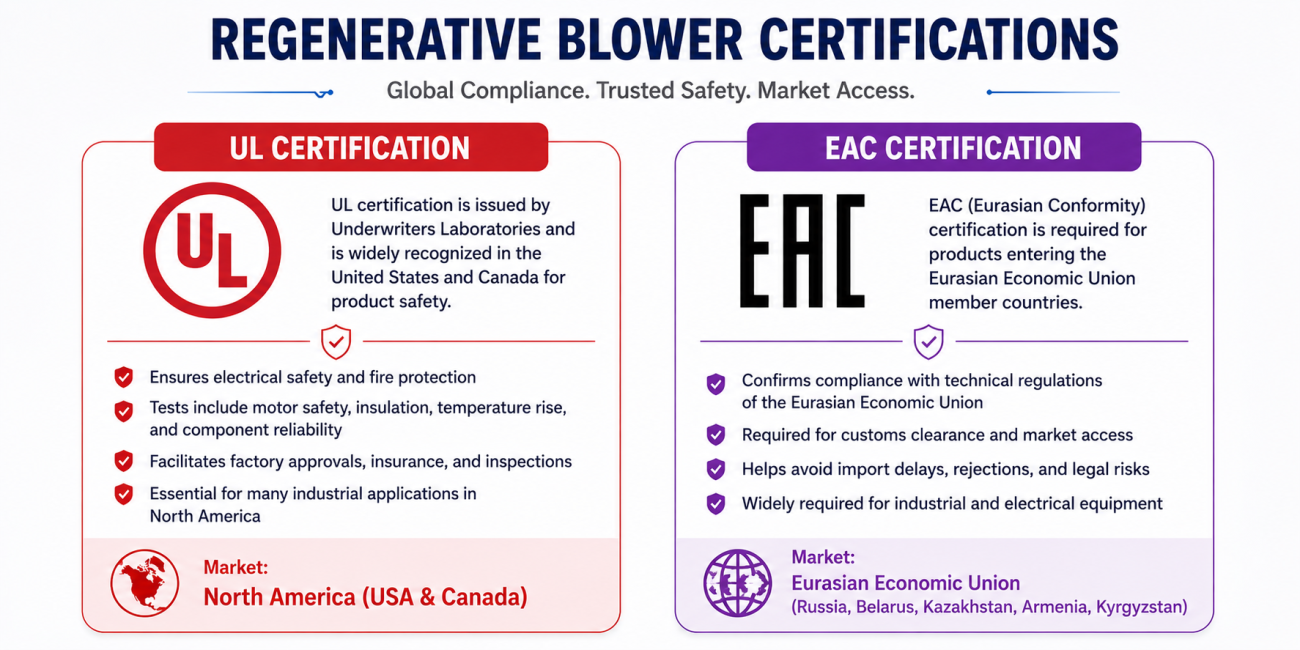
UL certification is issued by Underwriters Laboratories and is highly recognized in:
- The United States
- Canada
- North American industrial markets
UL focuses heavily on electrical safety and fire prevention.
Why UL Matters for Industrial Buyers
Many North American customers specifically request UL-certified regenerative blowers because they simplify:
- Factory safety approvals
- Insurance compliance
- Electrical installation inspections
- OEM integration
In some industrial facilities, non-UL equipment may not be allowed to operate.
UL Requirements Often Include
- Motor safety testing
- Electrical insulation verification
- Temperature rise testing
- Wiring safety evaluation
- Component traceability
UL-certified blowers are especially common in:
- Packaging automation
- Medical systems
- CNC machinery
- Vacuum lifting systems
- Environmental equipment
For exporters targeting North America, UL certification significantly improves competitiveness.
EAC Certification for Russia and Eurasian Markets
What Is EAC Certification?
EAC stands for Eurasian Conformity.
It is required for products entering:
- Russia
- Belarus
- Kazakhstan
- Armenia
- Kyrgyzstan
Why EAC Matters
Without EAC certification, regenerative blowers may face:
- Customs clearance problems
- Import rejection
- Project approval issues
EAC certification confirms the equipment meets technical regulations within the Eurasian Economic Union.
Industries Using EAC-Certified Blowers
EAC regenerative blowers are commonly used in:
- Industrial manufacturing
- Mining support systems
- Wastewater treatment
- Pneumatic conveying
- Agricultural processing
Many Russian distributors specifically request EAC documentation before purchasing.
ATEX Certification for Explosive Environments
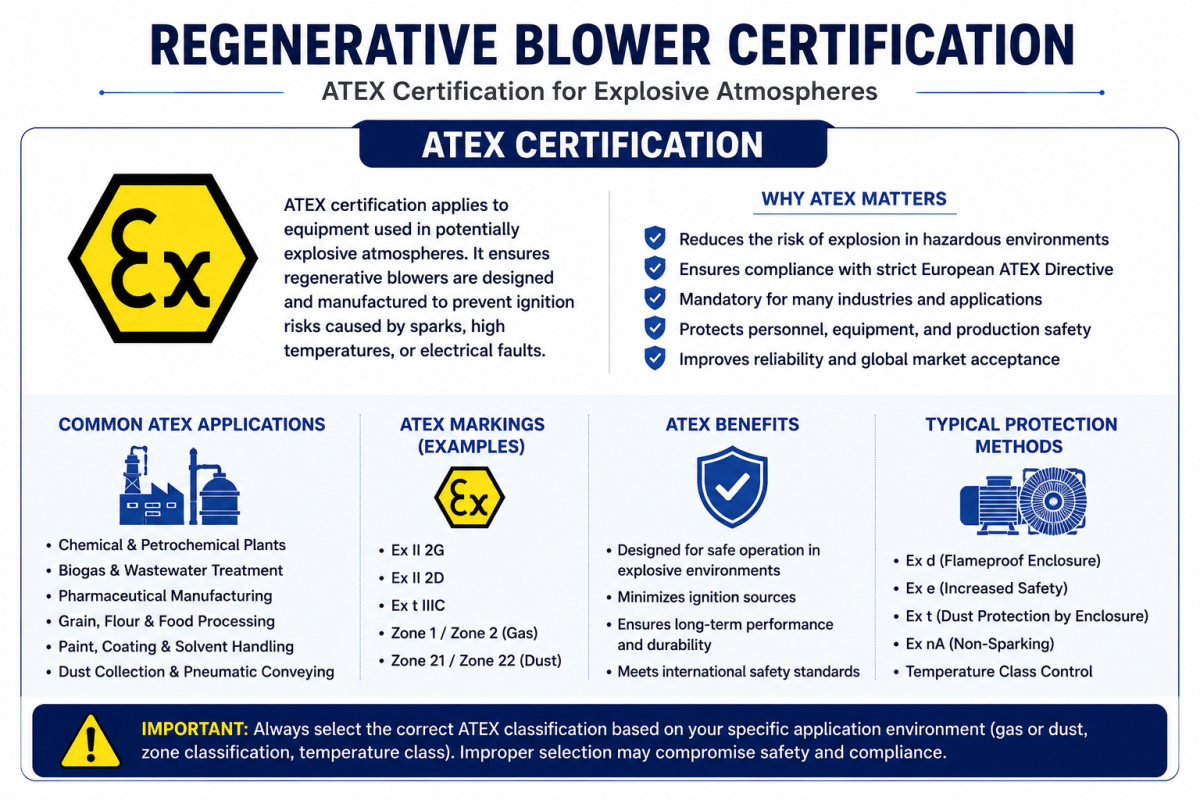
What Is ATEX?
ATEX certification applies to equipment used in explosive atmospheres.
This certification is critical for industries where flammable:
- Gas
- Dust
- Vapor
- Chemical particles
may exist.
Why ATEX Is Important for Regenerative Blowers
In hazardous environments, standard motors may generate:
- Sparks
- Excessive heat
- Static discharge
These conditions can create explosion risks.
ATEX-certified regenerative blowers are specially designed to reduce ignition hazards.
Common ATEX Applications
ATEX regenerative blowers are widely used in:
- Chemical plants
- Biogas systems
- Pharmaceutical production
- Grain processing
- Paint spraying systems
- Dust collection systems
Common ATEX Markings
Typical markings may include:
- Ex II 2G
- Ex t IIIC
- Zone 1
- Zone 21
Different ATEX classes correspond to different hazardous environments.
For many hazardous industrial projects, ATEX certification is mandatory.
Based on Different Certifications Available in the Market
Different markets require different compliance standards.
Europe
Recommended certifications:
- CE
- RoHS
- ATEX (if hazardous environment)
North America
Recommended certifications:
- UL
- CSA (sometimes required additionally)
China
Recommended certifications:
- CCC
Russia and Eurasian Countries
Recommended certifications:
- EAC
Important Questions Buyers Should Ask
Before purchasing a regenerative blower, buyers should confirm:
- Is the certification valid?
- Which organization issued the certificate?
- Does the certification apply to the full blower or only the motor?
- Is the certification suitable for the application environment?
- Are test reports available?
- Is the certification still active?
Some suppliers only certify certain components rather than the complete machine.
For hazardous environments, buyers should carefully verify ATEX classifications before installation.
Certification Does Not Replace Proper Selection
Even certified regenerative blowers must still be properly selected based on:
- Airflow
- Pressure
- Vacuum level
- Ambient temperature
- Installation altitude
- Duty cycle
- Dust or humidity conditions
A certified blower operating outside its design limits may still experience:
- Overheating
- Reduced lifespan
- Performance instability
- Motor damage
Proper engineering selection remains essential.
Conclusion
Regenerative blower certifications are more than labels on a nameplate. They represent safety, reliability, environmental compliance, and market accessibility.
Whether exporting to Europe, North America, Russia, or hazardous industrial sectors, understanding certifications like:
- CE
- RoHS
- CCC
- UL
- EAC
- ATEX
is essential for both manufacturers and buyers.
Choosing certified regenerative blowers helps ensure smoother international trade, safer industrial operation, and better long-term equipment reliability.