
 Pumps
PumpsThree-Phase vs Single-Phase Power: What’s the Difference

Electricity powers almost every part of modern life, from household appliances to large industrial machinery. However, not all electrical systems work the same way. Two of the most common types of power supply are single-phase power and three-phase power. While they may sound technical, understanding their differences is important for homeowners, factory managers, electricians, and equipment buyers.
Choosing the right electrical system affects efficiency, operating cost, equipment performance, and safety. In industrial applications such as regenerative blowers, compressors, pumps, and manufacturing equipment, selecting the proper power supply is especially critical.
This article explains the differences between three-phase and single-phase power in simple terms, including their working principles, advantages, disadvantages, and applications.
What Is Single-Phase Power?
Single-phase power is the most common electrical supply used in residential buildings and small commercial applications. It uses one alternating current waveform to deliver electricity.
In a single-phase system, power flows through two wires:
- One live wire
- One neutral wire
The voltage rises and falls continuously in a sine wave pattern. Since there is only one waveform, the power delivery is not constant and slightly drops during each cycle.
Main Characteristics of Single-Phase Power
- Simple electrical structure
- Common in homes and offices
- Lower installation cost
- Suitable for low-power equipment
- Typically used for lighting and household appliances
Common Applications of Single-Phase Power
Single-phase systems are widely used for:
- Air conditioners
- Televisions
- Refrigerators
- Computers
- Fans
- Small water pumps
- Household kitchen appliances
In many countries, single-phase voltage is usually:
- 110V–120V
- 220V–240V
depending on regional electrical standards.
What Is Three-Phase Power?
Three-phase power is mainly used in industrial and commercial environments where high power efficiency and stable electrical output are required.
Instead of one waveform, a three-phase system uses three alternating currents that are offset by 120 degrees from each other. This creates a continuous and balanced power flow.
A three-phase system typically includes:
- Three live wires
- One optional neutral wire
Because the phases overlap, the power delivery remains nearly constant.
Main Characteristics of Three-Phase Power
- Stable power transmission
- Higher efficiency
- Better for heavy-duty equipment
- Supports large motors and industrial machinery
- Lower energy loss during transmission
Common Applications of Three-Phase Power
Three-phase electricity is commonly used in:
- Manufacturing plants
- Wastewater treatment systems
- CNC machines
- Air compressors
- Regenerative blowers
- HVAC systems
- Conveyor systems
- Industrial pumps
Large equipment with continuous operation usually relies on three-phase power for smoother performance and better energy efficiency.
How Does Single-Phase Power Work?
In a single-phase system, the voltage alternates between positive and negative values. Since only one waveform exists, the power output momentarily reaches zero during each cycle.
This creates pulsating energy delivery.
For small appliances, this is usually not a problem. However, for large motors or industrial equipment, these fluctuations can reduce efficiency and create vibration.
Limitations of Single-Phase Motors
Single-phase motors often require:
- Additional starting capacitors
- Extra components for startup
- More maintenance in some cases
They also tend to have:
- Lower starting torque
- Reduced efficiency
- Higher operating temperature under heavy load
How Does Three-Phase Power Work?
Three-phase systems use three alternating currents working together. Since each phase reaches its peak at different times, power delivery remains continuous.
This creates smoother motor rotation and more efficient operation.
Benefits for Electric Motors
Three-phase motors offer several advantages:
- Self-starting capability
- Higher torque
- Lower vibration
- Better heat dissipation
- Longer service life
This is why industrial blowers and pumps are commonly designed for three-phase operation.
Key Differences Between Single-Phase and Three-Phase Power
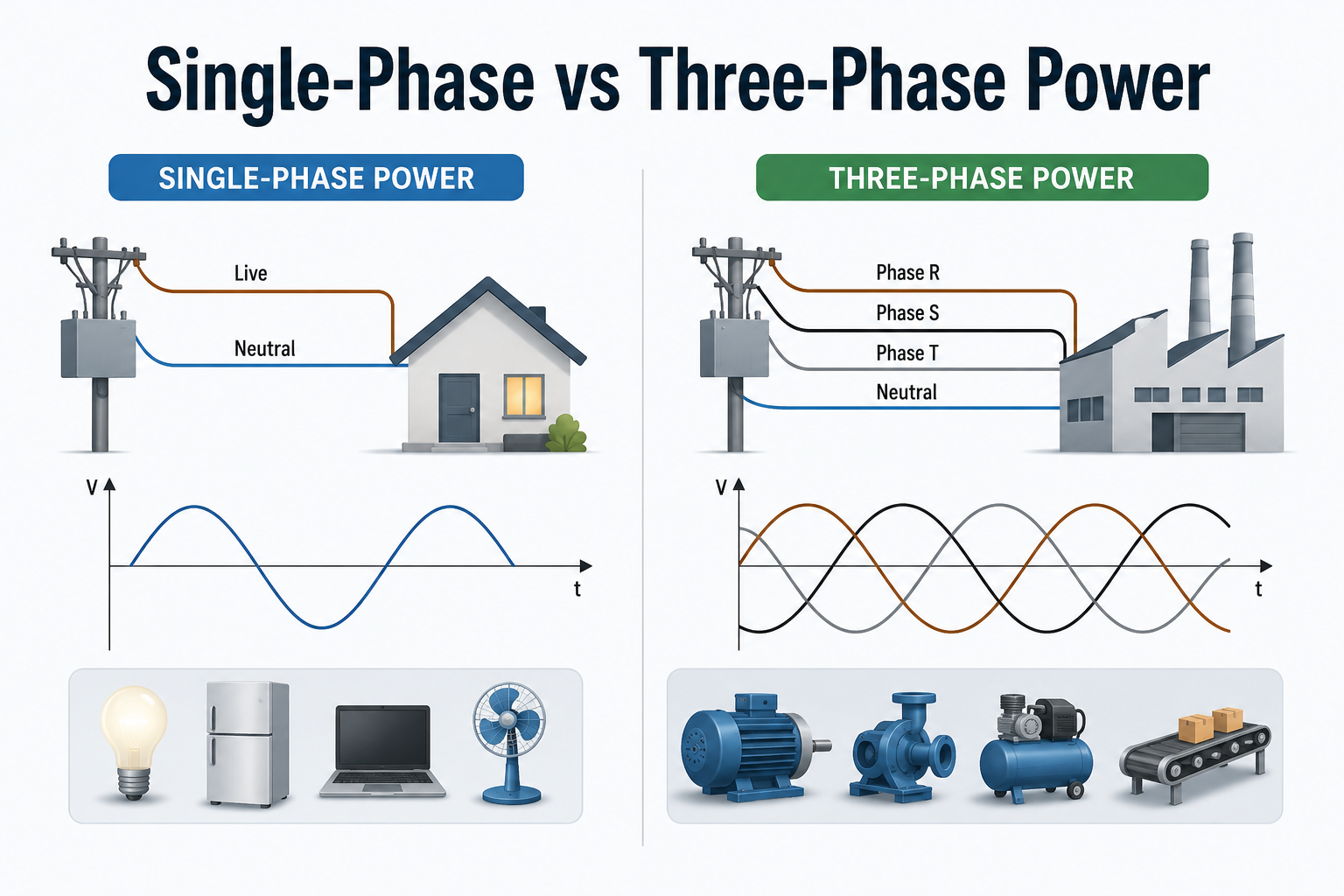
Understanding the major differences helps users choose the right system for their application.
Power Supply Stability
Single-Phase
- Power delivery fluctuates
- Temporary drops occur in each cycle
- Less stable under heavy loads
Three-Phase
- Continuous power flow
- Minimal fluctuation
- Stable operation for industrial equipment
Efficiency
Single-Phase
Single-phase systems are less efficient when handling high-power equipment.
Energy losses increase significantly under heavy loads.
Three-Phase
Three-phase systems transmit power more efficiently.
Advantages include:
- Lower energy consumption
- Reduced transmission losses
- Improved equipment performance
Motor Performance Comparison
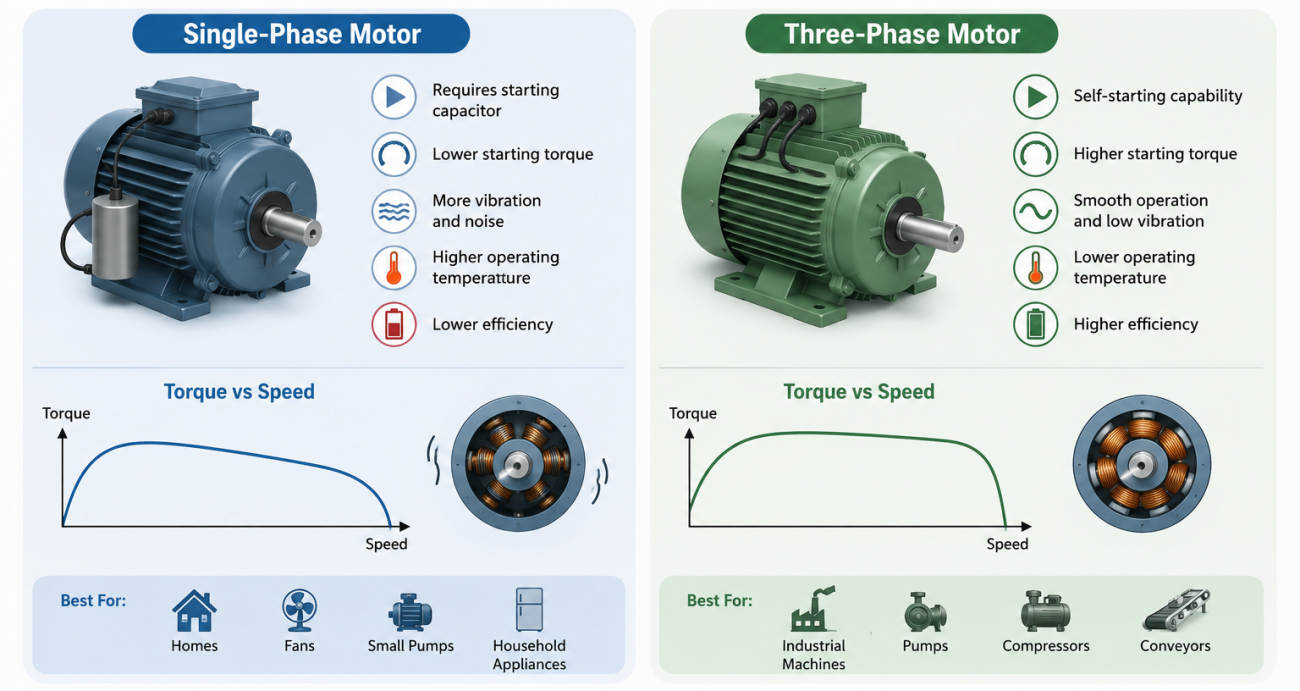
Motor operation is one of the biggest differences between these systems.
Single-Phase Motors
Single-phase motors are usually:
- Smaller
- Simpler
- Less expensive initially
However, they may experience:
- Reduced torque
- More vibration
- Lower efficiency
Three-Phase Motors
Three-phase motors provide:
- Smooth rotation
- Higher power output
- Better reliability
- Lower maintenance requirements
For industrial applications, three-phase motors are generally the preferred choice.
Installation Cost Comparison
Single-Phase Systems
Single-phase electrical systems are easier and cheaper to install.
Advantages include:
- Less wiring
- Lower equipment cost
- Simple maintenance
This makes them ideal for residential use.
Three-Phase Systems
Three-phase installations require:
- Additional wiring
- More complex distribution panels
- Higher initial investment
However, operating costs are often lower over time due to improved efficiency.
Which One Is Safer?
Both systems can be safe when properly installed and maintained. However, three-phase systems require more professional handling because of higher power capacity.
Safety Considerations
For both systems:
- Proper grounding is essential
- Circuit breakers should be installed
- Overload protection is necessary
- Electrical inspections should be performed regularly
Industrial environments using three-phase equipment must follow strict electrical safety standards.
Advantages of Single-Phase Power
Single-phase power remains popular because of its simplicity and affordability.
Main Benefits
- Lower installation cost
- Easy maintenance
- Suitable for homes
- Compatible with common appliances
- Simple electrical design
For light-duty applications, single-phase power is often sufficient.
Advantages of Three-Phase Power
Three-phase systems dominate industrial applications for good reasons.
Main Benefits
- Continuous power delivery
- Higher efficiency
- Better motor performance
- Lower operating cost
- Reduced vibration
- Longer equipment lifespan
Industrial machinery operating continuously benefits greatly from three-phase electricity.
Single-Phase vs Three-Phase: Which Is Better?
There is no universal answer because the best option depends on the application.
Choose Single-Phase Power If:
- You are powering a home
- Energy demand is low
- Equipment is small
- Installation budget is limited
Choose Three-Phase Power If:
- You operate industrial machinery
- Equipment runs continuously
- High efficiency is important
- You use large motors or blowers
Factories, workshops, and manufacturing facilities typically rely on three-phase systems.
Why Industrial Equipment Uses Three-Phase Power
Industrial machines require stable and reliable power. Three-phase electricity provides the consistency needed for demanding applications.
Benefits for Industrial Equipment
Three-phase systems help:
- Reduce motor overheating
- Improve operational stability
- Lower maintenance costs
- Increase production efficiency
Equipment such as regenerative blowers performs significantly better with three-phase motors because airflow and pressure output remain stable during continuous operation.
Can Single-Phase Equipment Be Converted to Three-Phase?
Yes, conversion is possible in some situations.
Common methods include:
- Variable Frequency Drives (VFDs)
- Phase converters
- Rotary converters
However, conversion adds complexity and cost. In many industrial cases, using native three-phase equipment is more practical.
Energy Consumption Comparison
Three-phase systems are generally more energy-efficient than single-phase systems under heavy loads.
Why Three-Phase Saves Energy
- Balanced power distribution
- Lower transmission loss
- Reduced motor strain
- Improved power factor
For factories operating equipment 24/7, these savings can become substantial over time.
Conclusion
Single-phase and three-phase power systems serve different purposes. Single-phase electricity is ideal for homes and small businesses because it is simple and affordable. Three-phase electricity, on the other hand, is designed for industrial and commercial applications where efficiency, stability, and high performance are essential.
When selecting electrical equipment such as pumps, compressors, or regenerative blowers, understanding the power supply requirements is extremely important. Using the correct power system not only improves efficiency but also extends equipment lifespan and reduces maintenance costs.
In general:
- Single-phase power works best for light-duty applications
- Three-phase power is better for industrial and heavy-duty operations
Choosing the right system ultimately depends on your power demand, budget, and application environment.