

 Pumps
PumpsExplosion Proof Regenerative Blower Guide

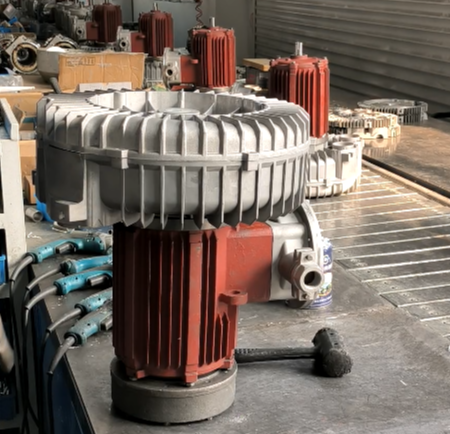
In industries where flammable gases, dust, or vapors are present, equipment selection is not just about performance—it’s about safety. A regenerative blower used in the wrong environment can become an ignition source. That’s why explosion proof regenerative blowers are specifically designed to operate safely under hazardous conditions.
Instead of changing how the blower works, the focus is on preventing sparks, controlling temperature, and ensuring any internal ignition does not spread to the outside environment.
What Is an Explosion Proof Regenerative Blower?
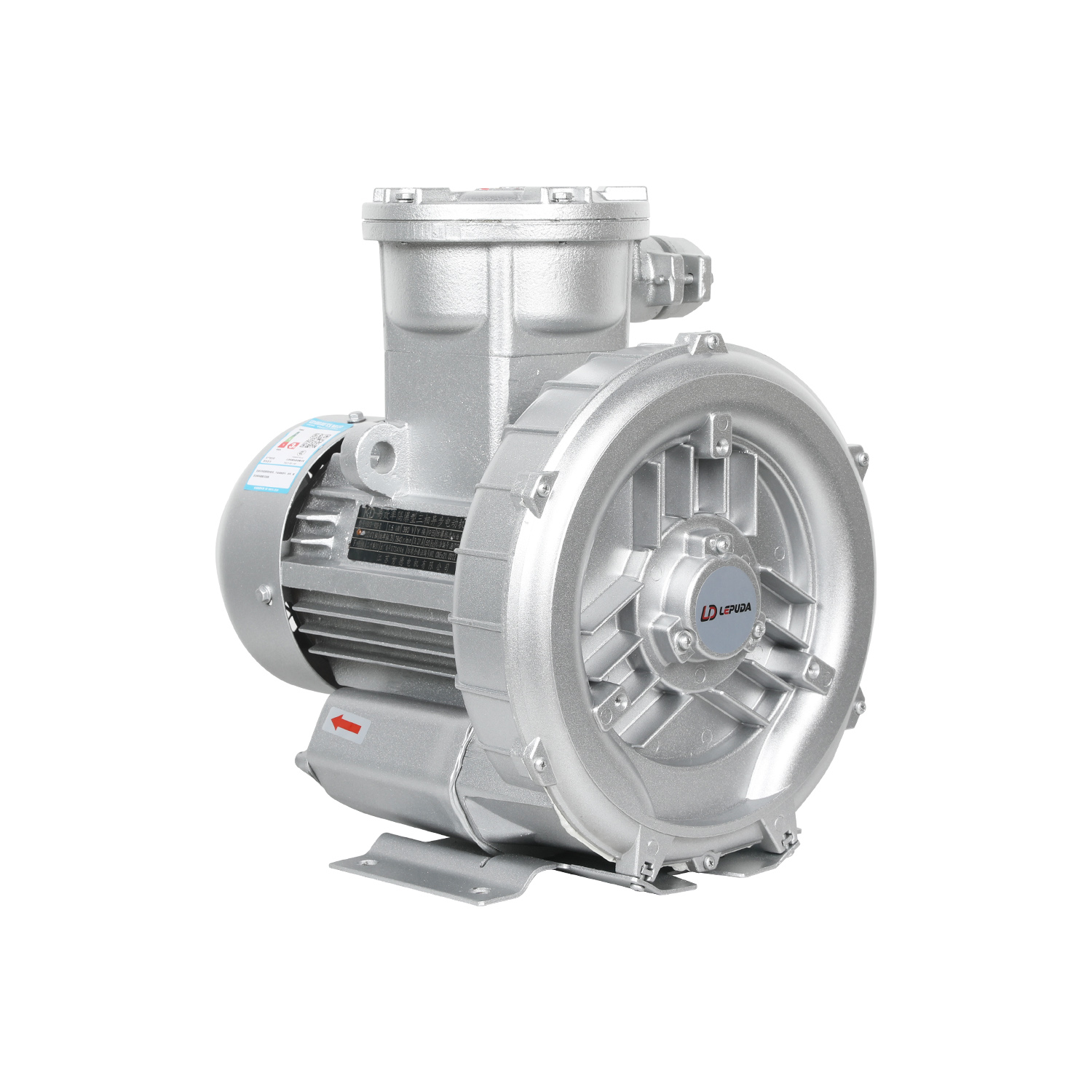
An explosion proof regenerative blower is a modified version of a standard side channel blower, designed for use in hazardous areas where explosive atmospheres may exist.
It does not mean the blower cannot explode under any circumstance. The real purpose is:
- To prevent internal sparks from igniting external gases or dust
- To contain any internal explosion within the equipment
- To keep surface temperatures below ignition thresholds
In simple terms, it’s about eliminating ignition risks rather than resisting explosions.
How the Blower Works (Same Principle, Safer Design)
The working principle remains unchanged. The blower still uses an impeller to accelerate air inside a side channel, building pressure through repeated circulation.
- Air enters the channel
- The impeller increases velocity
- Pressure builds gradually
- Air exits with stable pressure or vacuum
The difference lies entirely in the safety design, not airflow performance.
Where Explosion Proof Design Focuses
In most cases, explosion protection is not applied to every single part. The key focus areas are those most likely to create ignition risks.
Explosion Proof Motor
The motor is the most critical component.
- Fully enclosed structure prevents sparks from escaping
- Reinforced housing can contain internal ignition
- Special cable entries block gas intrusion
- Certified to standards like ATEX or IECEx
In practical applications, when people refer to an “explosion proof blower,” they are often mainly referring to the explosion proof motor.
Anti-Sparking Structure
Mechanical friction can generate sparks if not controlled.
- Use of non-ferrous materials in critical areas
- Precision machining to reduce contact risk
- Controlled clearances between rotating parts
This reduces the chance of accidental ignition during operation.
Temperature Control
Surface temperature is a hidden risk.
- Heat dissipation design keeps external temperature stable
- Thermal protection prevents overheating
- Matches required temperature class (e.g., T4)
If the surface temperature exceeds the ignition point of surrounding gas, even a spark-free machine can become dangerous.
Sealing and Protection
Hazardous gases and dust must be kept out of sensitive areas.
- High-quality sealing systems
- Dust-proof and gas-tight design
- Stable enclosure ratings
This ensures internal components remain isolated from explosive atmospheres.
Typical Hazardous Environments
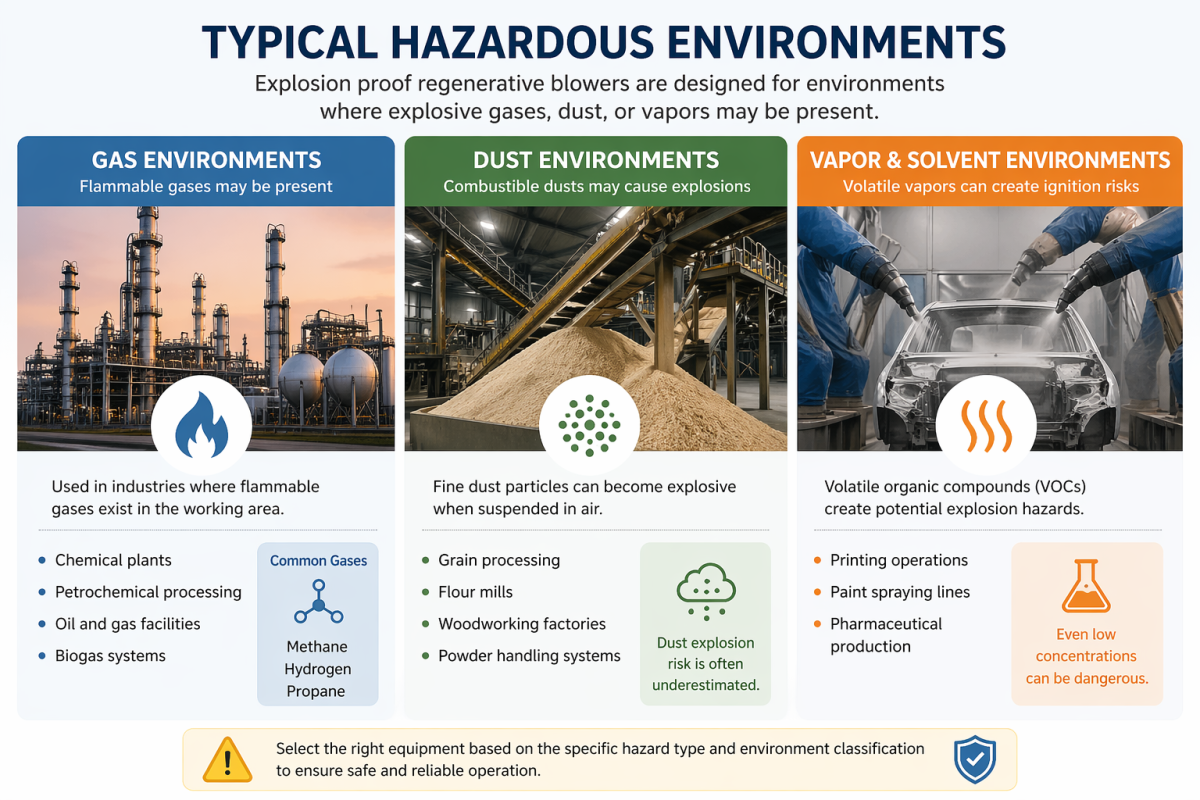
Explosion proof regenerative blowers are only necessary in specific conditions. Using them in normal environments is unnecessary and costly.
Gas Environments
Common in industries where flammable gases are present:
- Chemical plants
- Petrochemical processing
- Oil and gas facilities
- Biogas systems
Typical gases include methane, hydrogen, and propane.
Dust Environments
Fine particles can become explosive when suspended in air.
- Grain processing
- Flour mills
- Woodworking factories
- Powder handling systems
Dust explosions are often underestimated but can be just as dangerous as gas explosions.
Vapor and Solvent Environments
Volatile organic compounds create ignition risks.
- Printing operations
- Paint spraying lines
- Pharmaceutical production
Even low concentrations of solvent vapors can pose a hazard in enclosed spaces.
How to Choose the Right Explosion Proof Blower
Selection is not only about pressure and flow. Safety classification is equally important.
Hazard Classification
Identify the type of risk:
- Gas groups (IIA, IIB, IIC)
- Dust classifications where applicable
This determines the required protection level.
Temperature Class
Each environment has a maximum allowable surface temperature.
- T1 to T6 classifications
- Must match the ignition temperature of the medium
Choosing the wrong class can invalidate the entire safety system.
Certification Requirements
Make sure the blower complies with local standards:
- ATEX for Europe
- IECEx for international use
- Other regional certifications if required
Documentation and labeling must be clear and verifiable.
Installation Conditions
Consider the real working environment:
- Ambient temperature
- Ventilation conditions
- Indoor or outdoor installation
These factors directly affect safety and performance.
Advantages in Real Use
Explosion proof regenerative blowers offer several practical benefits:
- Safe operation in hazardous environments
- Oil-free air, suitable for clean processes
- Compact structure compared to other explosion proof equipment
- Stable airflow with low pulsation
- Relatively low maintenance when properly installed
Limitations You Should Not Ignore
They are not always the best choice for every situation.
- Higher cost due to certification and materials
- Heavier and more complex structure
- Strict installation and compliance requirements
- Limited flexibility for modification
Using explosion proof equipment where it’s not needed increases cost without adding value.
When Do You Actually Need One?
An explosion proof regenerative blower becomes necessary when:
- Flammable gases or dust are present in the working area
- The site is classified as a hazardous zone
- Safety regulations require certified equipment
- There is a real risk of ignition from electrical or mechanical sources
If none of these conditions apply, a standard blower is usually sufficient.
Conclusion
Explosion proof regenerative blowers are designed with one clear objective: eliminate ignition risk in hazardous environments. The core airflow mechanism remains unchanged, but the motor, materials, sealing, and temperature control are all optimized for safety.
In most cases, the key upgrade lies in the motor, supported by structural and thermal design improvements. Understanding this helps avoid overcomplicating selection while still meeting safety requirements.
If your application involves combustible gases, dust, or vapors, choosing a properly certified explosion proof blower is not just a technical decision—it’s a necessary step to ensure operational safety and compliance.