

 Pumps
PumpsCentrifugal Blower Working Principle: How a Medium Pressure Blower Works


A centrifugal blower, also known as a medium pressure blower, is an industrial air-moving device designed to deliver stable airflow at moderate pressure. It is commonly used in drying, cooling, ventilation, combustion air supply, pneumatic conveying, dust collection, and industrial equipment.
Unlike an axial fan, which moves air parallel to the rotating shaft, a centrifugal blower changes the airflow direction. Air enters through the center of the impeller and is discharged outward through centrifugal action.
What Is a Centrifugal Blower?

A centrifugal blower uses a rotating impeller to increase the speed and pressure of air or gas.
It normally operates between the performance ranges of a low-pressure fan and a high-pressure blower. This makes it suitable for applications that require:
- Higher pressure than a standard ventilation fan
- Larger airflow than many high-pressure blowers
- Stable operation under moderate resistance
- Continuous industrial airflow
- Reliable performance in connected pipe systems
A centrifugal blower may be directly driven by a motor or connected through belts and pulleys.
Main Components of a Centrifugal Blower
Impeller
The impeller is the main rotating component. Its blades accelerate the incoming air and push it outward.
Common impeller designs include:
- Forward-curved blades
- Backward-curved blades
- Backward-inclined blades
- Radial blades
Different blade designs affect airflow, pressure, efficiency, noise, and dust-handling capability.
Blower Housing
The housing, also called the volute casing, surrounds the impeller.
Its spiral shape collects the high-speed air leaving the impeller and directs it toward the outlet. It also helps convert part of the air velocity into static pressure.
Motor
The motor provides the power required to rotate the impeller.
Motor selection depends on:
- Required airflow
- Working pressure
- Impeller size
- Rotational speed
- System resistance
- Operating conditions
Inlet and Outlet
Air enters through the inlet near the center of the impeller and leaves through the outlet after gaining velocity and pressure.
The outlet direction can often be adjusted according to the installation layout.
How Does a Centrifugal Blower Work?
The centrifugal blower working principle can be explained in five main steps.
1. Air Enters the Inlet
When the motor starts, the impeller rotates and creates a low-pressure area near its center.
This pressure difference draws air into the blower through the inlet.
2. The Impeller Accelerates the Air
The air enters the rotating impeller blades. Mechanical energy from the motor is transferred to the air.
As the impeller rotates, the air gains speed and moves from the center toward the outer edge.
3. Air Changes Direction
The incoming air initially moves in the same direction as the shaft. The impeller then redirects it outward.
This change in airflow direction is a key characteristic of centrifugal blower operation.
4. The Housing Collects the Air
The high-velocity air leaving the impeller enters the volute casing.
The housing collects the airflow around the impeller and guides it toward the discharge outlet.
5. Velocity Is Converted Into Pressure
As the air moves through the expanding housing, its velocity decreases.
Part of the velocity energy is converted into static pressure before the air is discharged into the connected system.
This pressure allows the blower to overcome resistance from:
- Pipes and ducts
- Filters
- Valves
- Elbows
- Silencers
- Air knives
- Processing equipment
Why Is It Called a Medium Pressure Blower?
A medium pressure blower produces more pressure than a standard industrial fan but less pressure than a side channel blower, positive displacement blower, or air compressor.
It is suitable for systems that require a balance between airflow and pressure.
Medium pressure centrifugal blowers are often selected when the application needs:
- Large airflow volume
- Moderate pressure
- Stable continuous operation
- Efficient air movement
- Resistance to pipes and accessories
The exact pressure range depends on the impeller design, motor power, rotational speed, and blower size.
How Impeller Design Affects Performance
Forward-Curved Impeller
Forward-curved blades rotate in the same direction as the impeller.
Typical characteristics include:
- High airflow at lower speed
- Compact design
- Suitable for clean-air applications
- Commonly used in HVAC and light ventilation systems
Backward-Curved Impeller
Backward-curved blades bend against the direction of rotation.
Their main advantages include:
- Higher efficiency
- Stable performance
- Lower energy consumption
- Good pressure generation
- Suitable for continuous industrial operation
They are widely used in drying, cooling, combustion air, and process ventilation.
Radial-Blade Impeller
Radial blades extend outward from the center of the impeller.
They provide:
- Strong construction
- Good dust-handling capability
- Resistance to particles
- Reliable operation in demanding environments
They are commonly used in dust collection, material conveying, and industrial exhaust systems.
Airflow and Pressure
Airflow and pressure are the two main parameters used to select a centrifugal blower.
Airflow
Airflow refers to the volume of air supplied within a specific period.
Common units include:
- Cubic meters per hour
- Cubic meters per minute
- Cubic feet per minute
- Liters per second
The required airflow depends on the equipment capacity, number of outlets, process speed, and application demand.
Static Pressure
Static pressure represents the blower’s ability to overcome resistance in the system.
Resistance may be caused by:
- Long pipelines
- Small pipe diameters
- Filters
- Multiple elbows
- Control valves
- Air nozzles
- Heat exchangers
As resistance increases, the actual airflow normally decreases. Therefore, the blower should be selected according to its working point rather than only its maximum airflow.
Centrifugal Blower Performance Curve

A blower performance curve shows the relationship between airflow and pressure.
It may also include:
- Motor power
- Efficiency
- Rotational speed
- Operating range
The point where the blower curve meets the system resistance curve is called the operating point.
Selecting a blower close to its efficient operating range can provide:
- Lower energy consumption
- Reduced noise
- Less vibration
- Stable airflow
- Longer service life
An oversized or undersized blower may waste energy or fail to provide the required performance.
Factors That Affect Blower Performance
Several factors influence the performance of a medium pressure centrifugal blower.
Rotational Speed
Higher speed normally increases airflow and pressure. However, it may also increase power consumption, noise, heat, and mechanical stress.
A variable frequency drive can be used to adjust blower speed.
Impeller Size
A larger impeller can usually generate more airflow or pressure, but it also requires more motor power and installation space.
Air Temperature and Density
Hot air is less dense than cold air. High temperatures or high-altitude conditions may reduce blower pressure and affect performance.
System Resistance
Long pipes, narrow ducts, filters, elbows, and valves increase pressure loss.
A poorly designed piping system can significantly reduce airflow.
Inlet Conditions
The blower inlet should remain clear and unrestricted.
Blocked or turbulent inlet airflow may increase noise and reduce efficiency.
Common Applications of Medium Pressure Blowers
Industrial Drying
Centrifugal blowers provide continuous airflow for:
- Bottle drying
- Packaging drying
- Surface drying
- Textile drying
- Component drying
The airflow may be delivered through air knives, nozzles, or drying chambers.
Cooling
They are used to cool:
- Motors
- Electrical equipment
- Machinery
- Production materials
- Industrial processes
Combustion Air Supply
Furnaces, burners, and boilers require a stable air supply for efficient combustion.
A centrifugal blower helps maintain consistent airflow during operation.
Pneumatic Conveying
Medium pressure blowers can move lightweight materials through pipelines, including:
- Plastic pellets
- Grain
- Powder
- Textile fibers
- Paper scraps
Dust Collection and Exhaust
They can also provide suction and exhaust airflow for:
- Dust collectors
- Fume extraction
- Welding smoke removal
- Machine ventilation
- Air filtration systems
Packaging and Printing Equipment
Centrifugal blowers are integrated into packaging and printing machines for:
- Product drying
- Sheet separation
- Cooling
- Air cleaning
- Material positioning
Centrifugal Blower vs. Side Channel Blower
A centrifugal blower and a side channel blower use different operating principles.
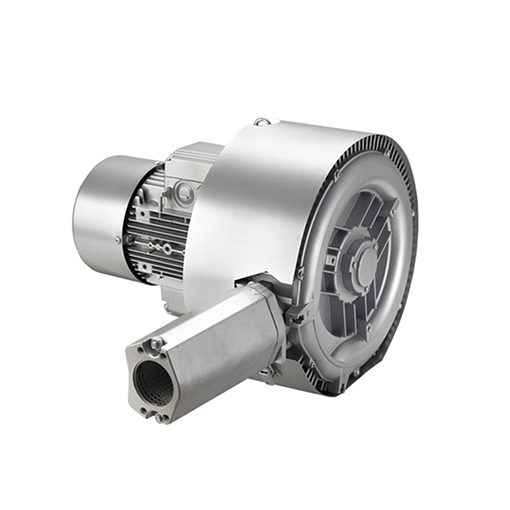
A centrifugal blower accelerates the air through an impeller and discharges it through a volute housing. It is generally suitable for larger airflow and medium-pressure applications.
A side channel blower repeatedly accelerates air inside a ring-shaped channel. It normally provides higher pressure or vacuum.
A centrifugal blower is commonly selected for:
- Cooling
- Ventilation
- Drying
- Combustion air
- Dust extraction
- Large-volume airflow
A side channel blower is commonly selected for:
- Vacuum holding
- Water aeration
- Pneumatic conveying
- Air knife systems
- Higher-pressure air supply
The correct choice depends on the required airflow, pressure, vacuum level, and system resistance.
Conclusion
The centrifugal blower working principle is based on using a rotating impeller to increase air velocity and pressure.
Air enters through the center of the impeller, moves outward through centrifugal action, and enters the volute housing. The housing then converts part of the air velocity into static pressure before discharging it into the system.
As a medium pressure blower, it offers a practical balance between airflow and pressure. It is widely used in drying, cooling, ventilation, combustion air, pneumatic conveying, dust collection, packaging, and industrial equipment.
Correct blower selection should be based on airflow, working pressure, system resistance, operating conditions, and the blower performance curve. Proper installation and regular maintenance help ensure stable airflow, efficient operation, and long service life.